
Page 43: of Marine Technology Magazine (Jun/Jul 2020)
Read this page in Pdf, Flash or Html5 edition of Jun/Jul 2020 Marine Technology Magazine
 42
42
 44
44
slopped walls, or protruding structures. the original point cloud had just under 8 quick to build, and easy to understand.
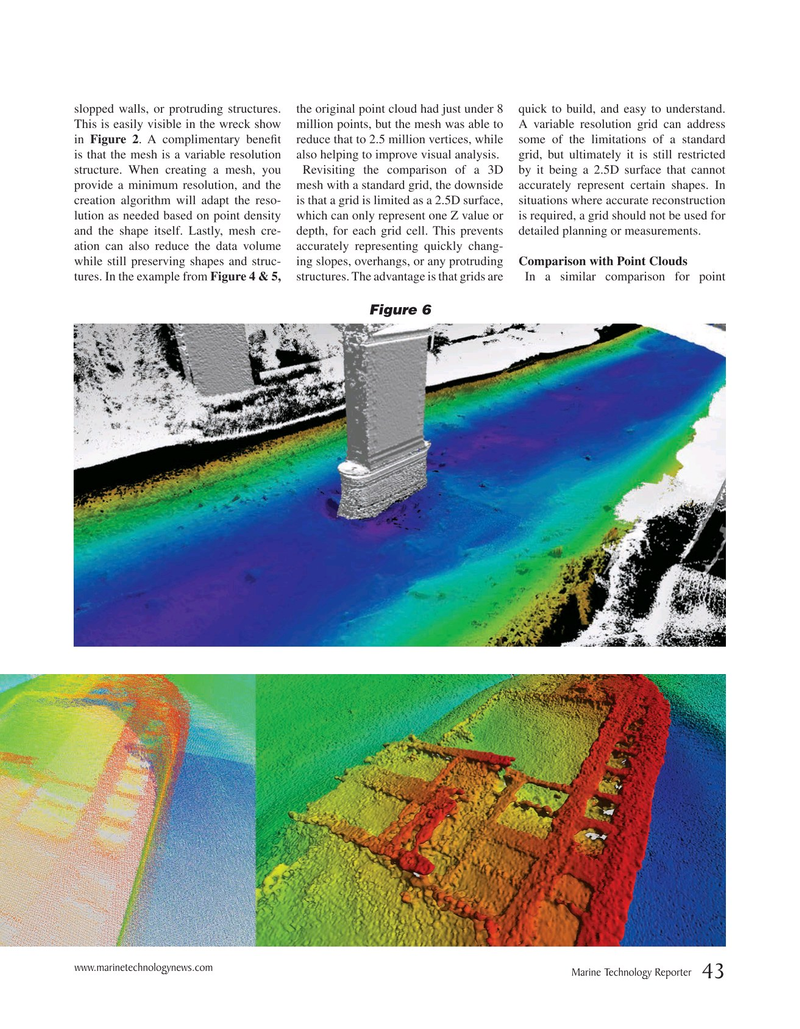
This is easily visible in the wreck show million points, but the mesh was able to A variable resolution grid can address in Figure 2. A complimentary beneft reduce that to 2.5 million vertices, while some of the limitations of a standard is that the mesh is a variable resolution also helping to improve visual analysis. grid, but ultimately it is still restricted structure. When creating a mesh, you Revisiting the comparison of a 3D by it being a 2.5D surface that cannot provide a minimum resolution, and the mesh with a standard grid, the downside accurately represent certain shapes. In creation algorithm will adapt the reso- is that a grid is limited as a 2.5D surface, situations where accurate reconstruction lution as needed based on point density which can only represent one Z value or is required, a grid should not be used for and the shape itself. Lastly, mesh cre- depth, for each grid cell. This prevents detailed planning or measurements. ation can also reduce the data volume accurately representing quickly chang- while still preserving shapes and struc- ing slopes, overhangs, or any protruding Comparison with Point Clouds tures. In the example from Figure 4 & 5, structures. The advantage is that grids are In a similar comparison for point
Figure 6 www.marinetechnologynews.com
Marine Technology Reporter 43