
Page 10: of Marine Technology Magazine (May/Jun 2025)
Read this page in Pdf, Flash or Html5 edition of May/Jun 2025 Marine Technology Magazine
 9
9
 11
11
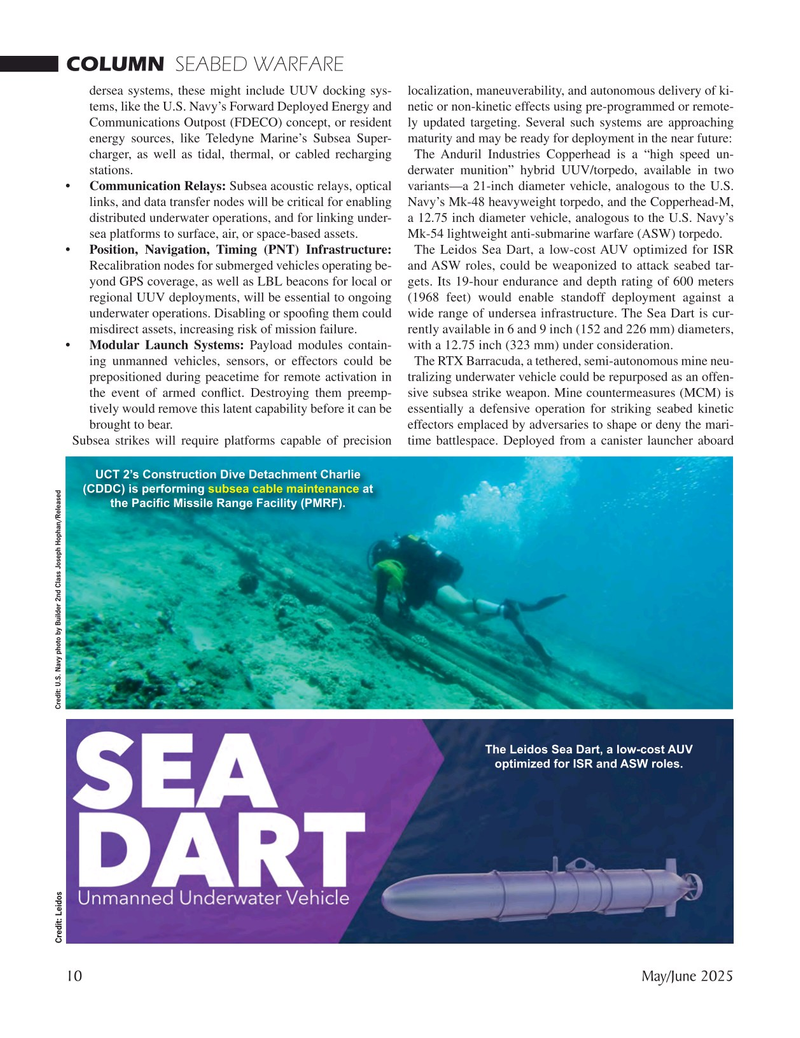
COLUMN SEABED WARFARE dersea systems, these might include UUV docking sys- localization, maneuverability, and autonomous delivery of ki- tems, like the U.S. Navy’s Forward Deployed Energy and netic or non-kinetic effects using pre-programmed or remote-
Communications Outpost (FDECO) concept, or resident ly updated targeting. Several such systems are approaching energy sources, like Teledyne Marine’s Subsea Super- maturity and may be ready for deployment in the near future: charger, as well as tidal, thermal, or cabled recharging The Anduril Industries Copperhead is a “high speed un- stations. derwater munition” hybrid UUV/torpedo, available in two • Communication Relays: Subsea acoustic relays, optical variants—a 21-inch diameter vehicle, analogous to the U.S. links, and data transfer nodes will be critical for enabling Navy’s Mk-48 heavyweight torpedo, and the Copperhead-M, distributed underwater operations, and for linking under- a 12.75 inch diameter vehicle, analogous to the U.S. Navy’s sea platforms to surface, air, or space-based assets. Mk-54 lightweight anti-submarine warfare (ASW) torpedo.
• Position, Navigation, Timing (PNT) Infrastructure: The Leidos Sea Dart, a low-cost AUV optimized for ISR
Recalibration nodes for submerged vehicles operating be- and ASW roles, could be weaponized to attack seabed tar- yond GPS coverage, as well as LBL beacons for local or gets. Its 19-hour endurance and depth rating of 600 meters regional UUV deployments, will be essential to ongoing (1968 feet) would enable standoff deployment against a underwater operations. Disabling or spoo